 By Jack Manu
 Introduction
If you are running a startup company or a technology-oriented business and looking to use AI to enhance customer experience, having a well-trained and unbiased model is essential. And you may already know that their accuracy depends on properly labeled data sets.
Managing data annotation in-house becomes time-consuming, expensive, and difficult to scale as your data grows.
Getting help from an experienced outsourcing partner can make all the difference. They know what they’re doing when it comes to training AI models. So let’s dive into why Data Annotation Outsourcing Services matter for building AI systems that are not just accurate, but fast and reliable too.
Do you really need Data Annotation for AI training?
Data annotation is the process of making raw data into structured training materials by naming it. So, AI models can easily understand and process them correctly. Data preparation improves exactness and reduces errors in AI systems.
- Includes tasks like image tagging, text classification, and audio transcription
- High-quality annotation helps minimize bias and improve reliability
- Errors in annotation can lead to serious issues, especially in sectors like healthcare and finance
- Better data labeling directly improves model performance and outcomes
What sort of data can be labeled
Now, let us look into the types of data annotation services that a reliable AI data labeling service provider like Velan offers.
Text Annotation:
NLP Data Annotation for chatbots and LLMs improves model efficiency and chatbot accuracy. Provides refined sets of data to process natural language.
Use Cases: Recommendation engines, sentiment analysis tools, OCR, and document processing.
Image Annotation:
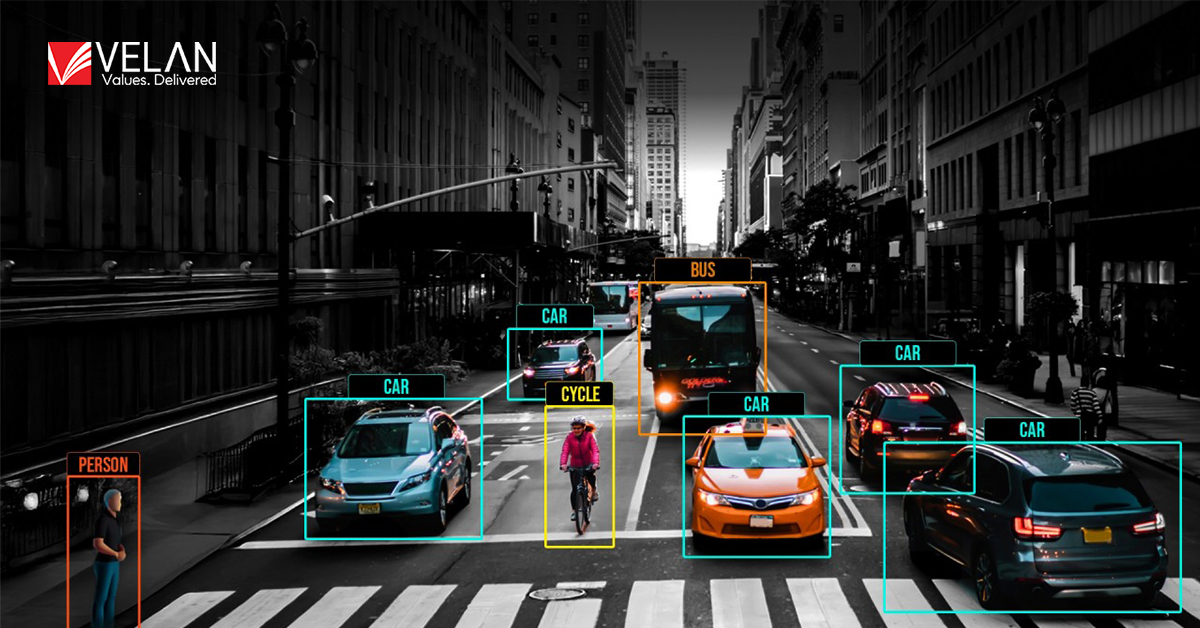
Computer Vision Models can be trained to perfectly comprehend visual data. The process encompasses object detection, categorization, and segmentation tasks.
Use Cases: Facial recognition, visual product search in e-commerce, autonomous vehicles, defect detection, and medical imaging.
Audio/Voice Annotation:
Tags speech data for voice recognition and voice assistants. Speech-to-text transcription, sound classification, and speaker identification are done to teach various audio-based AI assistants.
Use Cases: Voice assistants like Siri and Alexa, environmental sound detection, conversational AI, and medical consultation transcription.
Video Annotation:
Label objects and actions in video clips for AI understanding. Names moving objects frame by frame using polygons and bounding boxes.
Use cases: Training AI to recognize objects in motion, such as tracking pedestrians, vehicles, or traffic patterns.
3D LiDAR Annotation:
Annotates spatial data for autonomous systems and 3D mapping. LiDAR annotation outsourcing offers trained and experienced data annotators.
Use Cases: Driverless vehicles, robots, urbanization planning, precision agriculture, geo visualization, warehouse automation, and disaster management.
Data Annotation improves ML model accuracy
Raw data itself does not have meaning for a machine. This is where data labeling comes into action.
Tagging objects in an image or identifying the sentiment factor in a sentence helps the model learn what to look for. Completely labeled data helps the model recognize patterns easier and make them take better predictions.
- Good annotation helps reduce errors and improves consistency in results.
- Improves precision by reducing false positives or negatives.
- As more tagged data is used, the model continues to learn and improve.
- Labeled data helps your model understand the meaning and context in different business situations.
- Trained AI models produce unbiased results, which are highly needed for compliance.
- Labeled data sets are helpful in creating customized AI models for businesses like online shops and real estate.
In simple terms, better data annotation leads to better machine learning performance.
Want to know more? Read our article here: How Does Data Annotation Work for Machine Learning Models?
An outsourced team can help you build your trained AI model – The Benefits
Building an AI model with high-performance delivery requires more than just processed data. It needs the right expertise and quality checks in place. This is where a data annotation outsourcing partner plays a role. They bring in skilled teams, proven processes, and scalable resources to accelerate model training and improve accuracy.
- Access to Experts: Trained annotators follow best practices and industry standards for reliable outputs.
- Structured Quality Assurance: Regular audits and validation improve data accuracy and consistency.
- Faster Turnaround: Ready teams reduce development time and speed up model training.
- Scalability: Easily handle large datasets without delays.
- Cost Efficiency: Optimize budgets while maintaining high-quality annotation processes.
- Bias Reduction: Workflows led by talented teams help create fairer AI models.
Choosing a partner with strong domain experience and clear strategies, like Velan, can make a major difference in creating dependable AI assistants.
Looking to improve your AI model accuracy? Connect with our data annotation experts.
Data Annotation Market Trends
The data annotation industry has changed a lot as businesses seek better quality and reliable results. Companies now focus not just on cost, but also on expertise and long-term value. Let us see how the industry expectations have changed
- More companies are outsourcing work to skilled teams in different countries
- Use of the Best Data Annotation Tools and platforms to track work and quality in real time
- Better QA checks to reduce errors and improve accuracy
- Regular training to keep teams updated with new AI trends and technologies
- Following global standards to build trust and ensure compliance
- Opt for long-term partnerships over single projects.
Future of Data Annotation: How will it change?
As we said earlier, once a purely manual, labor-intensive task, annotation is now essential for AI success.
The global market for these services is projected to reach $3.6 billion by 2027. To meet the demand of various sectors, the data annotation industry is shifting away from simple 2D bounding boxes towards sophisticated workflows that combine speed, safety, and scale.
AI-Assisted and Automated Annotation:
ML algorithms do the initial labeling of data. Human annotators validate and adjust them for relevancy. This reduces manual effort for pixel-perfect segmentation.
Multimodal and Sensor Fusion Labeling:
Annotation is now turning towards combining multiple data types like text, audio, images, LiDAR, and radar information. This is useful for autonomous vehicles, robotics, and advanced healthcare AI.
Real-Time and Edge-Based Annotation:
Data is labeled instantly upon generation rather than in batches. This is necessary for immediate, time-sensitive applications like autonomous drones or live surveillance.
Synthetic Data Generation:
To address data scarcity and privacy concerns, developers are adopting artificial intelligence tools to create synthetic datasets.
Human-in-the-Loop:
Despite increased automation, the part played by human experts is important. They make sure accuracy, safety, and ethical standards in data annotation tasks.
Conclusion
As we have explored, the accuracy of your AI is anchored completely on the quality of its training sets. When you try to manage all these tasks with your internal team, it may drive employee burnout and errors.
Businesses can avoid these hurdles by partnering with an Expert Data Annotation Company like Velan. With their help, you tap into real expertise and solid quality checks that turn your bulk data into a real edge for your business. Outsourcing doesn’t just save you time—it helps you build real trust in your AI from the ground up.
Still trying to figure out how to boost your AI model’s accuracy? Talk to our consultants.