 By Jack Manu
 The data is used as fuel for artificial intelligence—but without appropriate tags, AI models can’t decipher what they are searching, reading or listening to. Thus, the necessity of tools for Data Annotation Service arises. These platforms play a big role in converting raw datasets into organized, human-readable training material for AI and machine learning systems.
The year 2026 will witness considerable enhancement in the field of annotation technology, escalation being brought about by the use of automation, AI-assisted labeling and workforce integration in software. The blog aims to provide insight into some of the top annotation software solutions that are currently used by the leading AI teams in various industries—whether you are searching for open-source annotation tools, enterprise labeling platforms or AI powered automation.
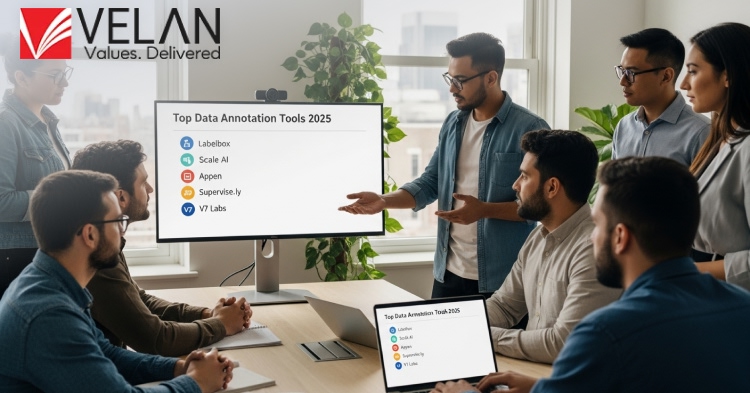
Top Data Annotation Tools in 2026
1. Labelbox—Best for Enterprises & Advanced Automation
Currently still regarded as one of the best labeling platforms. Labelbox is used in organizations that require sophisticated workflows and data governance. The platform comprises
- A modern web UI that serves to annotate image, video, text and LiDAR data through a GUI.
- AI-powered pre-labeling to speed up processes Review and QA workflows.
- Workforce management and optional managed labeling services
- Integrations with MLOps tools like Vertex AI and Databricks
Why choose it?
It employs analytical approaches, ensures compliance, and uses hybrid AI/Human labeling.
It is perfectly suited for scaling annotation projects.
2. Scale AI (Scale Data Engine)
Best for large-scale AI operations. It is important to recognize that Scale AI focuses on the mission-critical labeling function supporting computer vision as well as NLP, Robotics and autonomous driving. Here’s what you get:
- A skilled team of human labelers who know what they’re doing.
- Pre-labeling and smart error detection—automation handles the boring stuff and helps catch mistakes early.
- Continuous feedback to keep the AI getting smarter over time.
- Custom workflows, so you can handle those weird, tricky cases nobody else wants to touch.
So, why go with this one?
It remains a wise choice for teams working with big data and industries where close-to-perfect solutions are required.
3. CVAT — Top Open-Source Annotation Tool for Computer Vision
CVAT (Computer Vision Annotation Tool) is popular for bounding boxes and video tracking as well as segmentation tasks. First, it covers both image and video annotation—no need to switch tools. If you’re labeling video, the interpolation tools save a ton of time. Want to keep everything private? You can run it on your own servers. There’s also a plugin system, so you can tweak the workflow until it fits just right. Plus, there’s a big community if you ever get stuck.
Why choose it?
It’s spot-on for engineering teams who want total control over their data and don’t want to deal with licensing fees. If you’re working with computer vision projects, this setup just makes sense.
4. Label Studio—Most Flexible Open-Source Multimodal Tool
Label Studio really lets you make it your own. The labeling interface is super customizable, and it doesn’t care what kind of data you throw at it: text, images, videos, audio, or even time-series stuff.
You get templates for complex labeling workflows, plus it plays nicely with machine learning pre-annotations. And when it comes to setup, you can go cloud or self-hosted—whatever works for your team.
Why does it stand out?
Teams juggling NLP, vision, and audio projects can’t get enough of it. It’s flexible, and the extra features go a long way.
5. Supervisely—Best for 3D, LiDAR & Medical Data
Supervisely shines when you need to handle advanced 3D data or work in industrial AI. It covers video and image labeling for big autonomous systems, plus it comes loaded with point cloud and LiDAR annotation tools. Medical imaging? It’s got built-in DICOM viewers for that. Training and dataset management are all baked right in.
Why use it?
If you’re building robotics, automotive tech, or medical AI, this platform is ready for production from day one. It just gets the job done.
How do you choose the right annotation software?
Honestly, it comes down to three things: the kind of data you have, how complicated your process is, and your budget. Here’s what you get:
1. Data Type Support
If you have images or video, you can use CVAT, Supervisely or V7.
Have NLP, text, or audio projects?
Label Studio and Scale AI are solid options.
Need 3D or LiDAR Support? Go with Supervisely.
2. Scalability & Automation
Labelbox gets you covered when you need corporate-level automation and analytics.
Dealing with large amounts of data and being as accurate as can be? Go with Scale AI.
3. Data Security & Access Control
Want to keep everything in-house? CVAT and Label Studio let you self-host.
Need cloud compliance and enterprise security? Labelbox and Amazon Ground Truth are your best bets.
4. Cost Model
Looking for free, open-source tools? Check out CVAT and Label Studio.
If you need a managed solution with extra support and workforce options, Scale, Labelbox, and Supervisely offer subscription and licensing plans.
5. Collaboration & Review Workflows
For strong QA and consistent data quality, pick platforms that support review layers and inter annotator agreement.
Data Annotation Following Trends In 2026
Now, most of the annotating is done by AI
| Platform | Type | Best Feature | Team Size Fit |
| Labelbox | Enterprise | Workflow automation and analytics | Mid-large |
| Scale AI | Enterprise | Humans in the loop and data engines | Large or global |
| CVAT | Open-source | Video & vision workflows | Technical teams |
| Label Studio | Open-source | Multimodal versatility | Researchers & startups |
| Supervisely | Enterprise/hybrid | 3D + medical support | Industry-focused orgs |
Data Annotation Following Trends In 2026
Now, most of the annotating is done by AI. Humans continue to play an important role in the more challenging pieces, but machines take care of much of the early labeling labor.
Even quality checks are going smarter. If the tool has built-in AI, it flags all possible mistakes instantly instead of letting them accumulate and turn into a nightmare.
Privacy’s a big deal. More companies want self-hosted or hybrid cloud setups to keep sensitive data locked down.
What are data engines? They’re not stopping at labeling. The new platforms link up everything—annotating, training, evaluating, even RLHF—into one ongoing cycle.
Final Thoughts
There’s no one-size-fits-all tool out there. So, which one is the best choice — well, that is up to your data type, the size of your project and your team, your budget, your compliance requirements, and how much customization or automation you demand. Whether that’s an enterprise option from a big name or an open-source one, the important bit is to have the good, clean, and reliable training data at the end that makes your AI learn better and faster.
FAQ: Best Data Annotation Tools in 2026
Which are the best data annotation tools in 2026?
Some of the leading tools right now are Labelbox, Scale AI, CVAT, Label Studio, and Supervisely. That is a question that only you can answer yourself. This is highly dependent on your data—the type of data, how much data needs labeling, and whether you want a turnkey enterprise solution or a more open-source, flexible solution.
What industries use annotation software?
Industries like autonomous vehicles, healthcare, retail, manufacturing, security, and NLP-based customer service use annotation tools to build computer vision, speech recognition, and language models.
How does AI help in data annotation?
The latest AI annotation tools have smart functions like auto pre-labeling, anomaly detection, smart suggestion etc., which not only speed up the operation but also increase accuracy and reduce manual work.